


Application of cyclic distillation technology
in the production of food-grade ethanol
High-purity, food-grade ethanol with minimal levels of fusel oils and impurities is used in applications where the purity of taste and aroma — and the absence of extraneous substances — are essential.
- Food and beverage industry: production of spirits, tinctures, liqueurs, and balms, where a high degree of purification preserves the smoothness and original aroma of the raw ingredients.
- Confectionery and baking: used as a preservative, a solvent for food colorings and flavorings, and a base for extracts (such as vanilla).
- Medicine and pharmaceuticals: preparation of medicinal tinctures, extracts, and antiseptic solutions.
- Cosmetics and perfumery: a base for perfumes, eau de toilette, lotions, and toners, where a neutral scent free from foreign impurities is essential.
- Home preparation: crafting tinctures, fruit-infused liqueurs, and homemade extracts.
Food-grade ethanol is produced through the alcoholic fermentation of starch- or sugar-containing plant raw materials, followed by rectification to remove impurities. During the production and purification (rectification) of ethyl alcohol, four main groups of volatile impurities are identified, which are categorized based on their boiling points and volatility relative to ethanol. Aldehydes, higher alcohols, esters, organic acids. The ethanol purification process line consists of seven distillation columns. Let us examine each of these columns, considering them in a cyclic configuration.
List of distillation equipment in the process flow scheme for the production of food-grade ethanol.
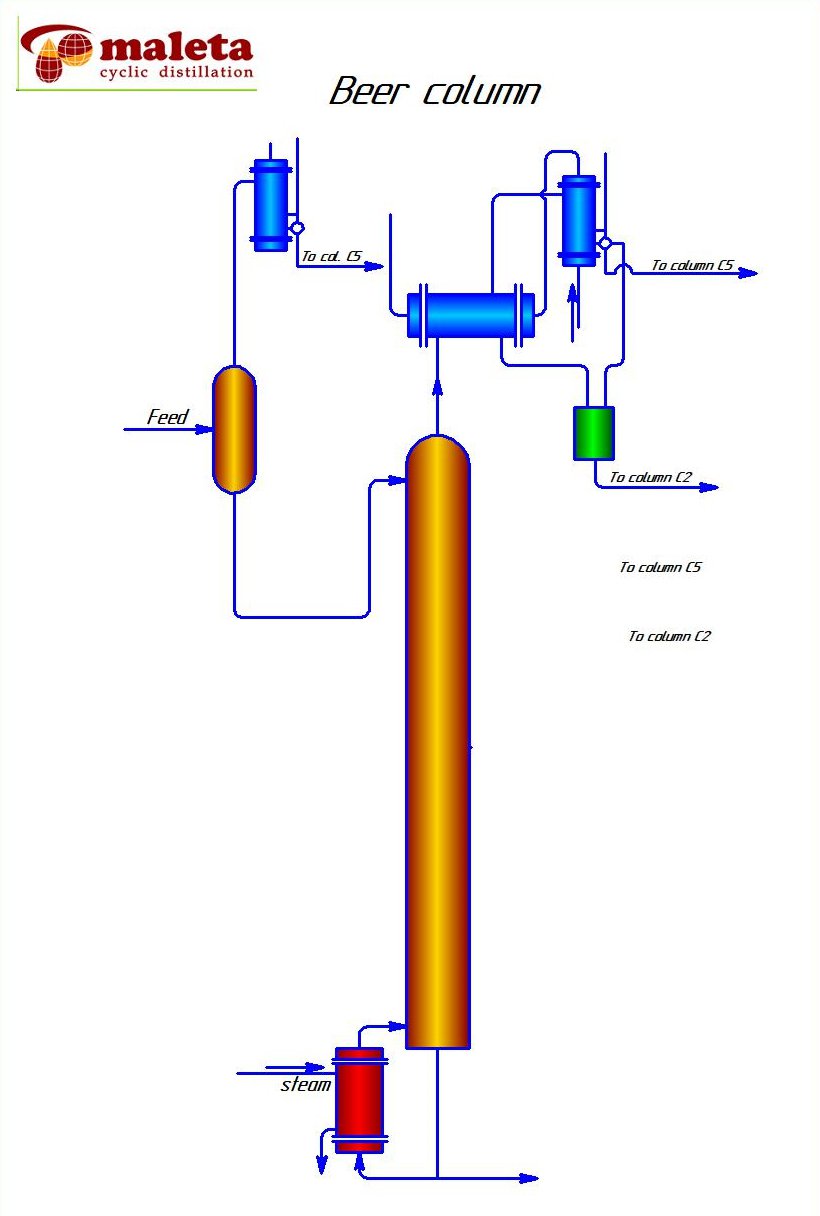
A beer column (mash column) is designed for distilling mash and separating alcohol along with its associated volatile impurities — from the spent grain residue (stillage). A traditional column can contain up to 30 trays, with a spacing of up to 300 mm between them. The ethanol concentration in the fermented mash is 7–15% by volume. Modeling and physical experiments on the operation of a distillation column in a cyclic mode have shown that the required ethanol concentration at the column outlet can be achieved with 10–12 trays, while saving up to 30% of the steam.
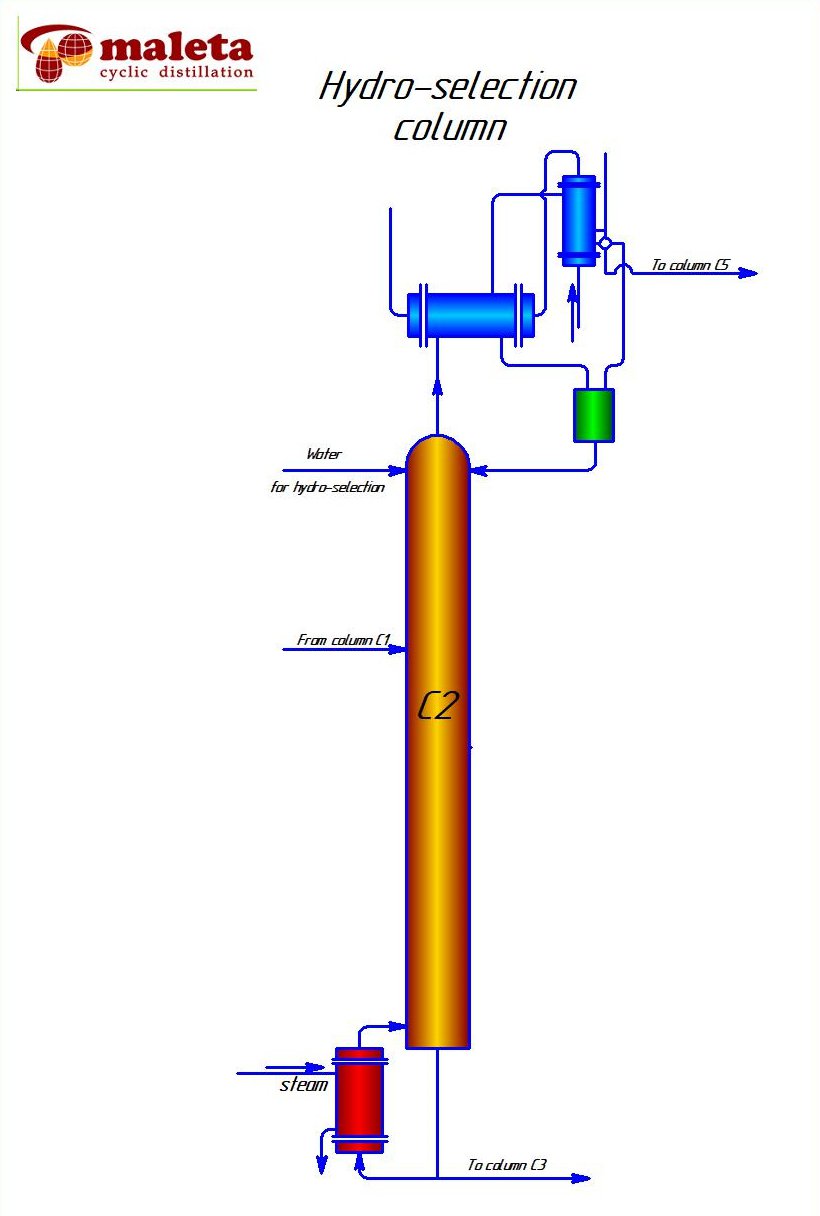
A hydroselection column is a key mass-transfer apparatus in the alcohol industry, designed to purify ethyl alcohol by removing volatile impurities—such as aldehydes, esters, methanol, and, to some extent, fusel oils. This is achieved through "hydroselection"—diluting the crude alcohol with hot water—which increases the volatility of the accompanying impurities. A traditional column can contain up to 60 trays, with a spacing of up to 300 mm between them. Industrial implementation of a cyclic hydro-selection column has demonstrated a requirement for 15 trays, while achieving steam cost savings of up to 25%.
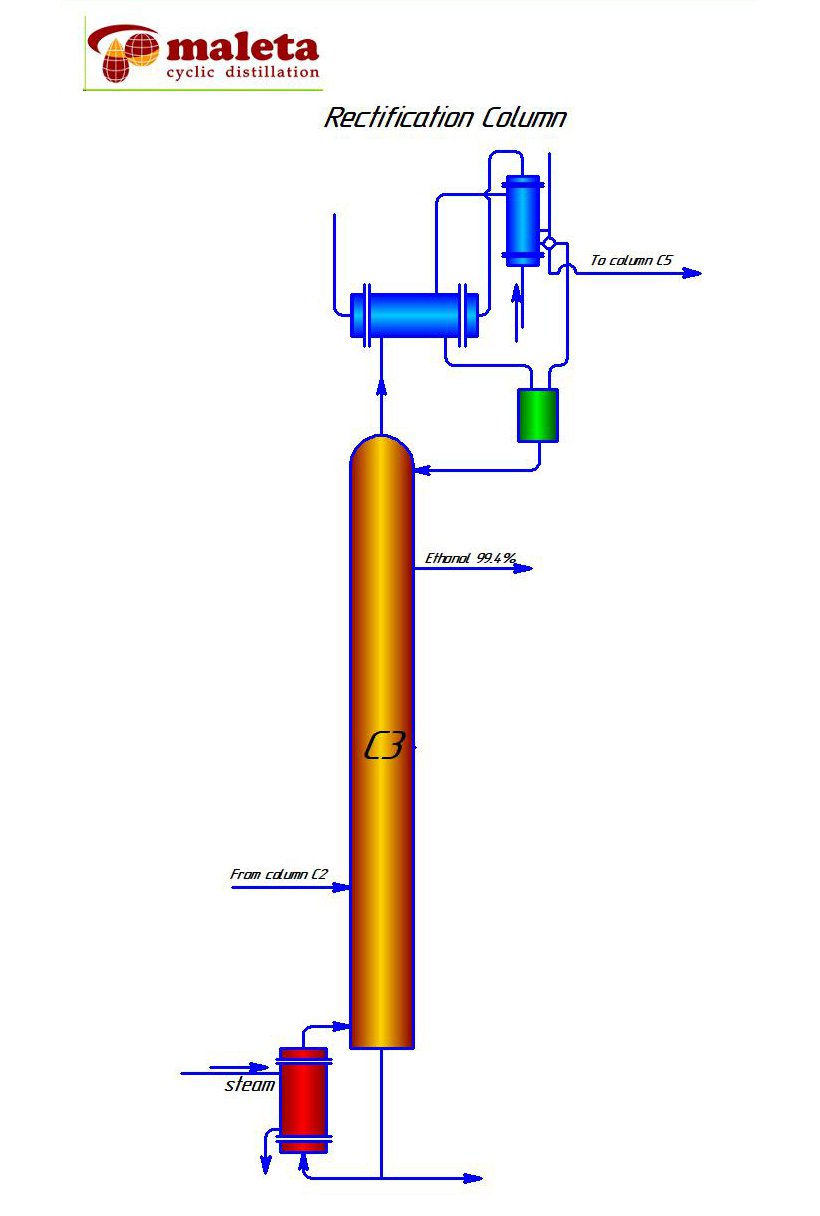
In the production of alcohol, an industrial rectification column is a complex, continuous-action heat and mass transfer apparatus designed to concentrate ethyl alcohol (up to 96.3–96.6% by volume) and thoroughly purify it by removing associated impurities (such as aldehydes, esters, fusel oils, methanol, and acids). A traditional column can contain up to 80 trays, with a spacing of up to 250 mm between them. Industrial implementation of a cyclic distillation column has demonstrated that 30 trays are sufficient to meet the required objectives, while also achieving up to 30% savings in steam costs.
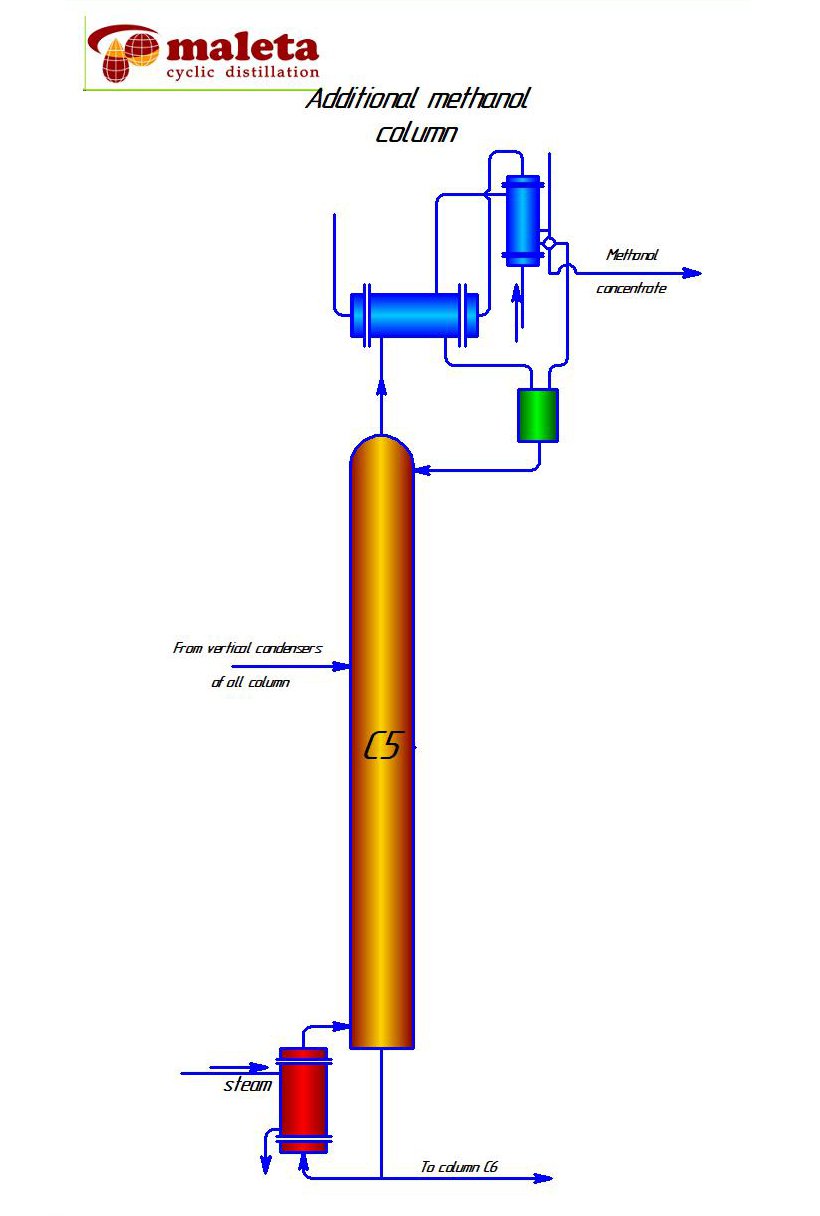
In distillation-rectification units, the methanol column is designed to concentrate methanol and remove it from the process. The feed to this column consists of all streams originating from the vertical condensers, as well as unpasteurized alcohols. A traditional methanol column may contain up to 80 trays, with a spacing of up to 250 mm between them. Industrial implementation of a cyclic distillation column has demonstrated that 20 trays are sufficient to achieve the desired objectives, while also providing up to 30% savings in steam costs. Moreover, when using a distillation column, the methanol content in the commercial food-grade ethanol will be less than 1 ppm.
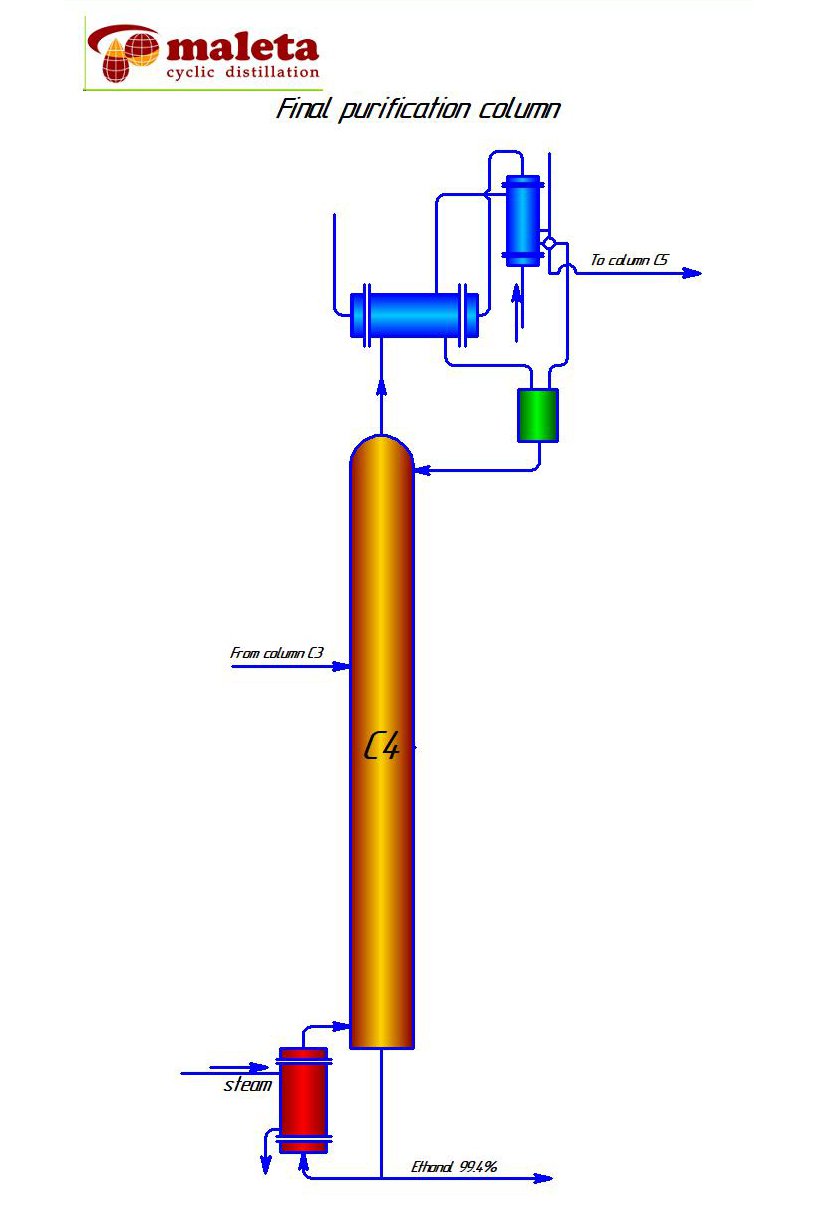
A final purification column is used at the concluding stage of the distillation and rectification process to remove methanol and other volatile impurities—which are difficult to separate—from the rectified alcohol, thereby enhancing the quality of the ethyl alcohol. A conventional column can contain up to 40 trays, with a spacing of up to 250 mm between them. Industrial implementation of a column for cyclic distillation has demonstrated that 20 trays are sufficient to achieve the desired objectives, while also providing up to 30% savings in steam costs.
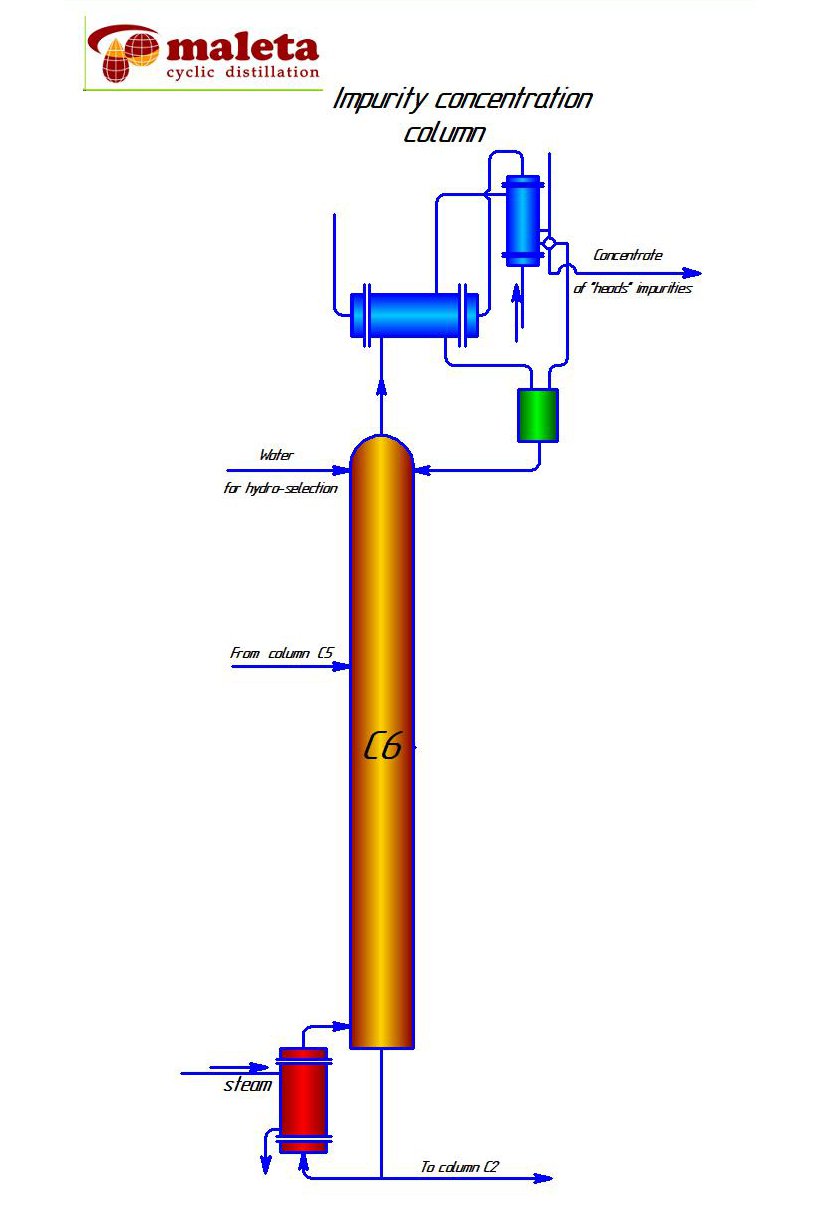
The impurity concentration column, serving as an auxiliary column, is designed to extract ethyl alcohol from distillates containing "head," "intermediate," and "tail" impurities (such as the ester-aldehyde fraction, fusel and to achieve maximum concentration of these impurities before they are removed from the production cycle. Traditional columns cannot handle such a task. Industrial implementation of a cyclic distillation column has shown that 15 trays are sufficient to meet the desired objectives and yield up to 30% savings in steam costs.
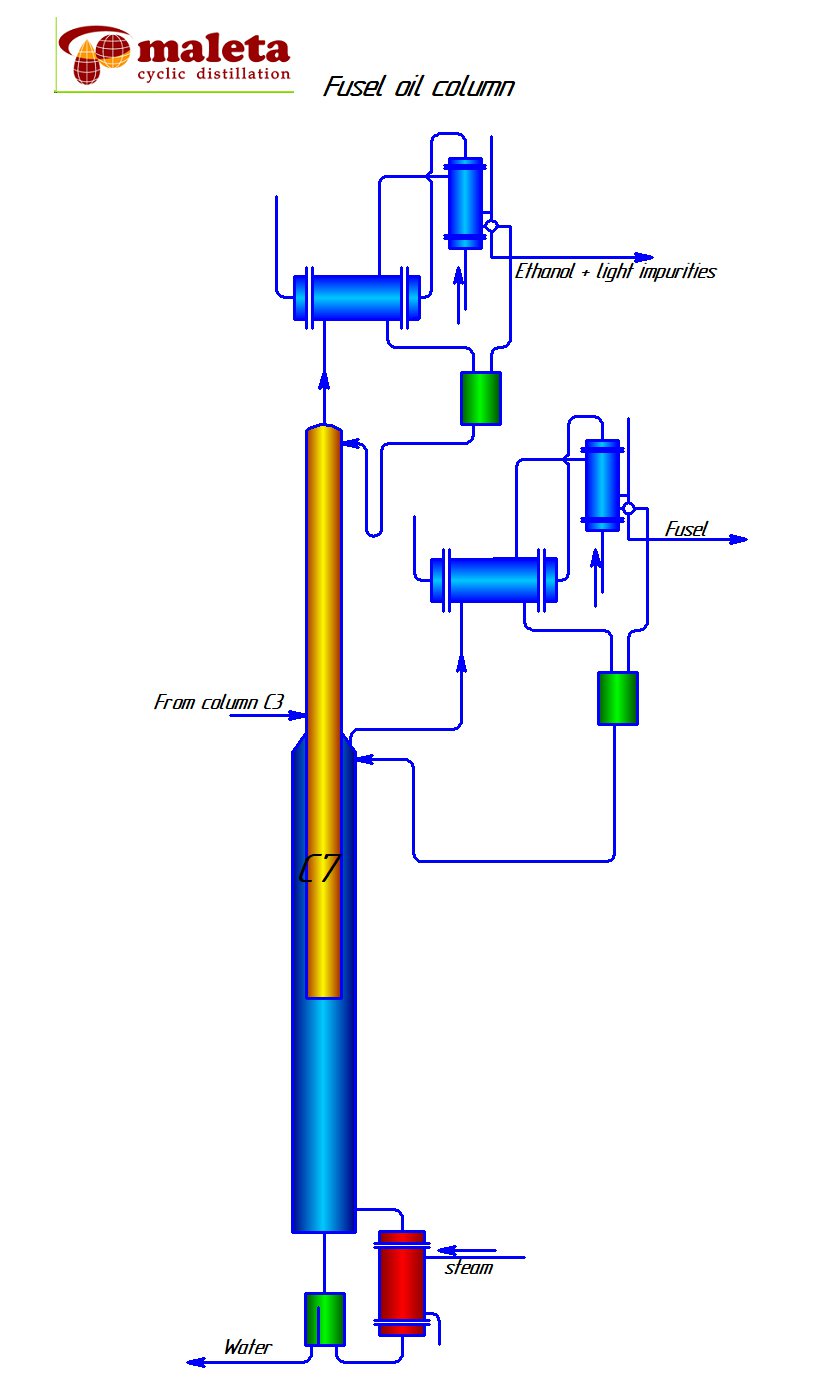
In distillation plants, the fusel oil column is designed to concentrate, separate, and extract higher alcohols from streams drawn off the alcohol and purification (epuration) columns, and to recover the ethyl alcohol contained in those streams. The telescopic DWC cyclic column separates the feed into three streams: ethanol, fusel oil, and water.
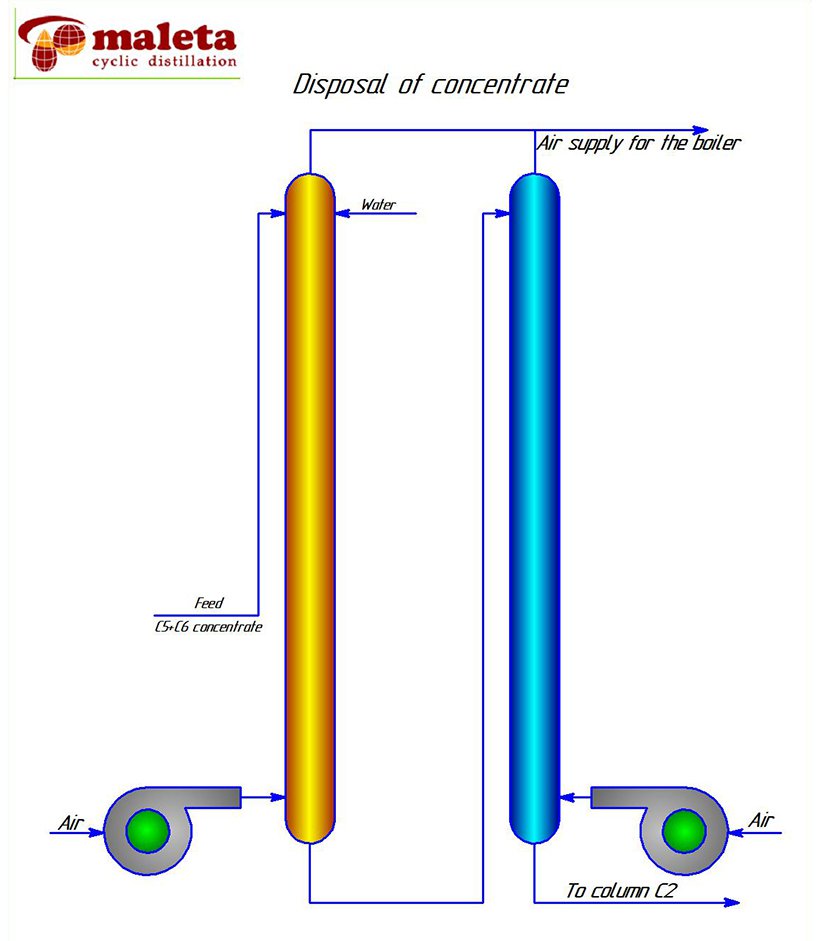
Concentrates from the methanol column and the impurity concentration column are processed in desorption columns using air. Impurities that enter the air are directed into the plant's boiler and burned there.